Hanging heavy frames without regret
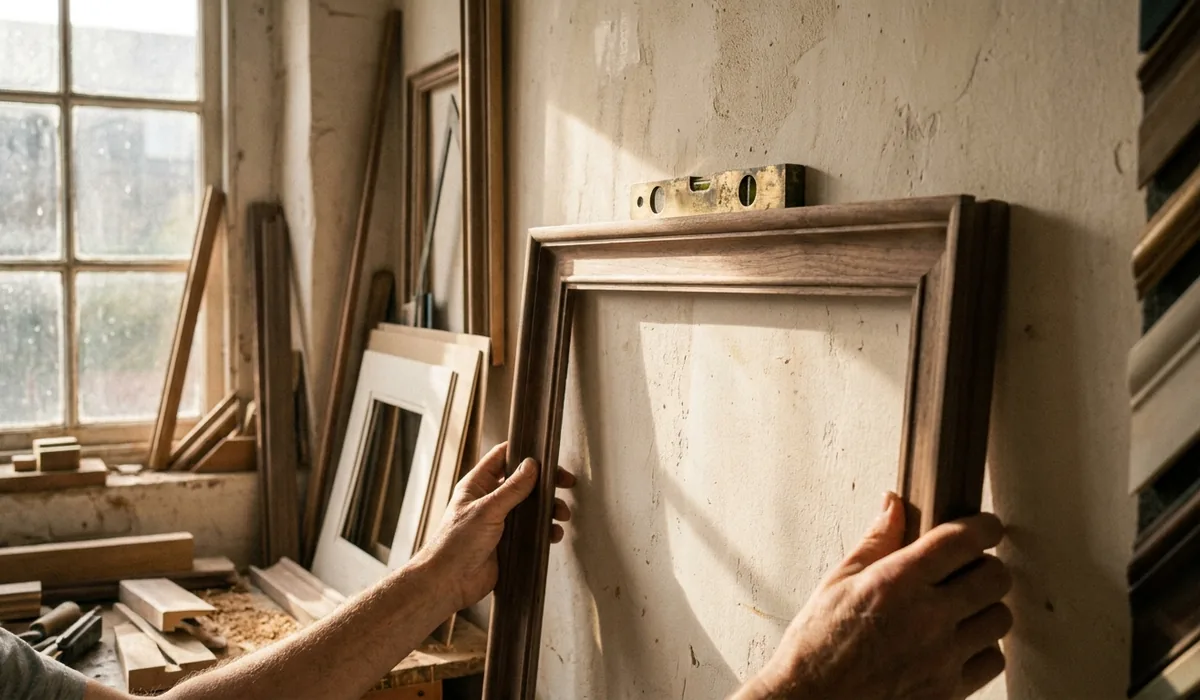
A frame we have spent a week building can be undone in a moment by the wrong hook. Most of the framed pieces that come to us damaged were not damaged in transit or in use — they fell off the wall. A little care at the hanging stage protects the work and your plaster, and it is not complicated once you know what the wall is made of.
Know your wall first
The wall decides everything. A solid masonry or brick wall will hold almost anything on the right plug and screw. A hollow plasterboard wall is a different problem: the board itself holds very little, so weight has to go either into a stud behind it or into a proper cavity fixing rated for the load. Find the studs with a detector, and if the frame is heavy, aim for them. Guessing here is how holes appear.
Two points, not one
A single central hook lets a frame swing and tilt, and every knock nudges it out of level. Two fixings, spaced perhaps a third in from each side, stop the swing and share the load. On anything wide or heavy we fit two D-rings to the back rather than a single wire, precisely so it can hang from two points. It is steadier, it stays level, and it halves the load on each fixing.
One hook holds a picture. Two hooks keep it where you put it.
Match the fixing to the weight
Picture hooks are rated — a small brass hook is for a light frame, and it is worth reading the number rather than assuming. For heavier work, use screws and wall plugs suited to the wall, or a proper hanging system. If you are near the top of a fixing's rating, step up to the next one; the cost difference is pennies and the failure mode is a broken frame on the floor.
Getting it level
- Mark the top corners lightly in pencil where you want them.
- Measure down from the hanging point on the back to the top of the frame, and transfer that to the wall so the hooks sit at the right height.
- For two-point hanging, use a spirit level (or a level app) between the two marks before you drill.
- Hang, then step back and check by eye — walls and ceilings are rarely perfectly square, and the eye wins over the level.
A note on where
Once it is up, light and damp are the long-term enemies. Keep valuable work off walls in direct sun and away from radiators and bathrooms. Good conservation glazing helps with the light; a sensible spot helps with everything else.
If you would rather not drill, we can fit the right hanging hardware before a piece leaves the studio and tell you exactly what your wall needs. Just ask when you collect.